
In this example from the Apex Property Operations developer org, Salesforce enforces required permissions when changing Case ownership. When a Field Operative user does not have the necessary read access on the Case and related records (Account/Contact), Salesforce prevents the transfer. This behavior underscores an important admin principle: object-level permissions must be aligned with record ownership before assignment can occur. Below, I explain what caused the error and how it was resolved using permission sets while maintaining least-privilege access.
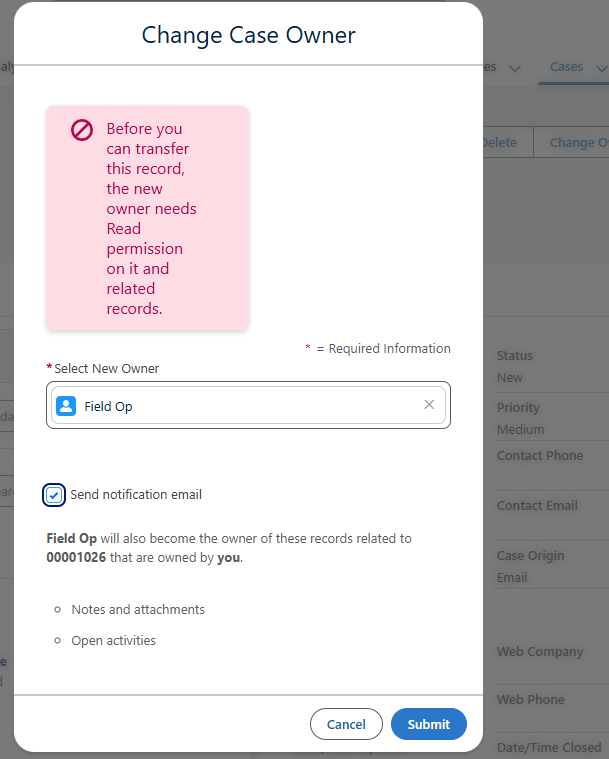
Permission Dependencies & Error Handling
While testing Case ownership assignment with Private OWD, I encountered a permission error preventing transfer of a Case to a Field Operative user. Salesforce requires that the new owner has Read access to the record and its related objects before ownership can be transferred.
This highlighted an important dependency between object permissions and record ownership. I resolved the issue by granting the Field Operative minimal access via a permission set:
- Read/Edit access to Cases
- Read access to related Accounts and Contacts
This approach maintained the principle of least privilege while allowing operational users to own and work assigned records. This reinforced the importance of designing object permissions and ownership together, rather than treating them as separate concerns.
⭐ STAR
Situation: Testing private Case visibility and ownership.
- Task: Assign Cases to Field Operatives securely.
- Action:Identified a permission dependency preventing ownership transfer and updated permission sets to grant minimal required access to Cases and related records.
- Result: Secure Case ownership with controlled access.
Note: In this Developer Org, Salesforce Platform licensing later influenced how Case ownership was implemented, reinforcing the importance of aligning security design with license constraints.
What this project taught me
This build reinforced how important it is to think beyond “making it work” and instead design with data integrity, user behaviour, and future scalability in mind.
In particular, this project highlighted:
- how small UI decisions can introduce data inconsistencies
- why automation and validation must work together
- and how real-world admin work often involves iterating and refining, not getting everything perfect first time
This is very much an evolving solution, and I expect to revisit and improve parts of it as my understanding deepens.
What I’d improve next time
If I were extending this further, I would:
- refine the user experience around record creation
- add clearer guardrails for edge cases
- and explore alternative approaches (such as screen flows or guided actions) where appropriate
Learning in Salesforce is rarely linear, and this project is a good example of how solutions mature over time.
🔹 Let’s talk
If you’re a Salesforce Admin, Architect, or Recruiter and would like to discuss this approach, trade ideas, or explore how I think through problems like this, feel free to connect with me on LinkedIn.